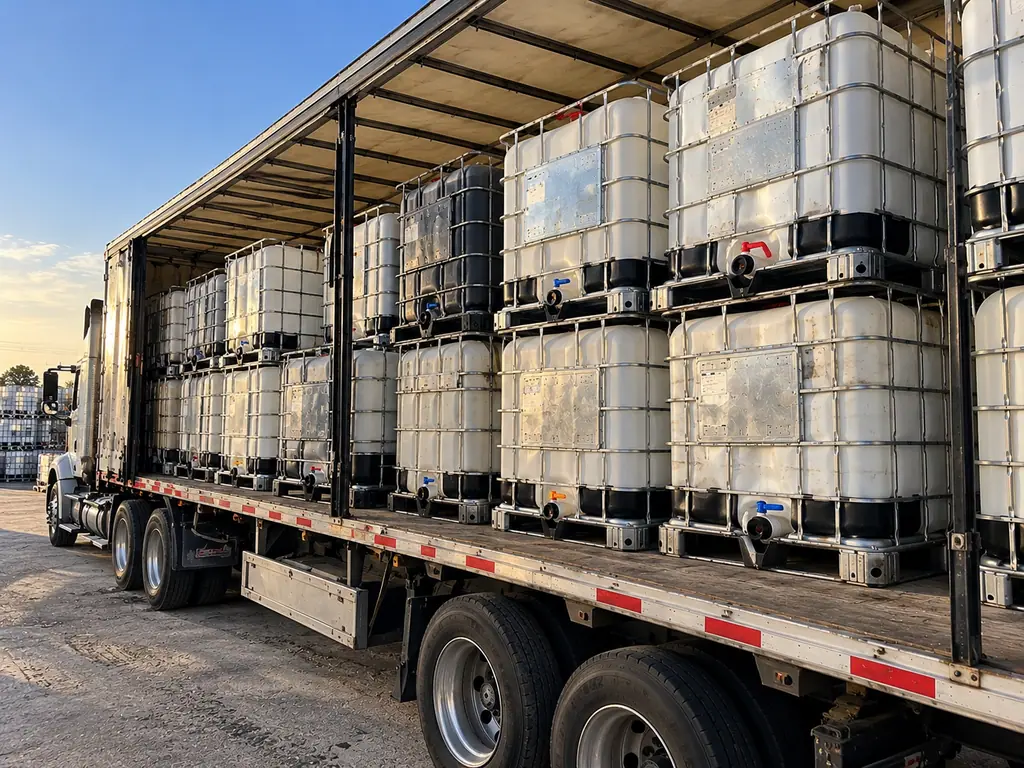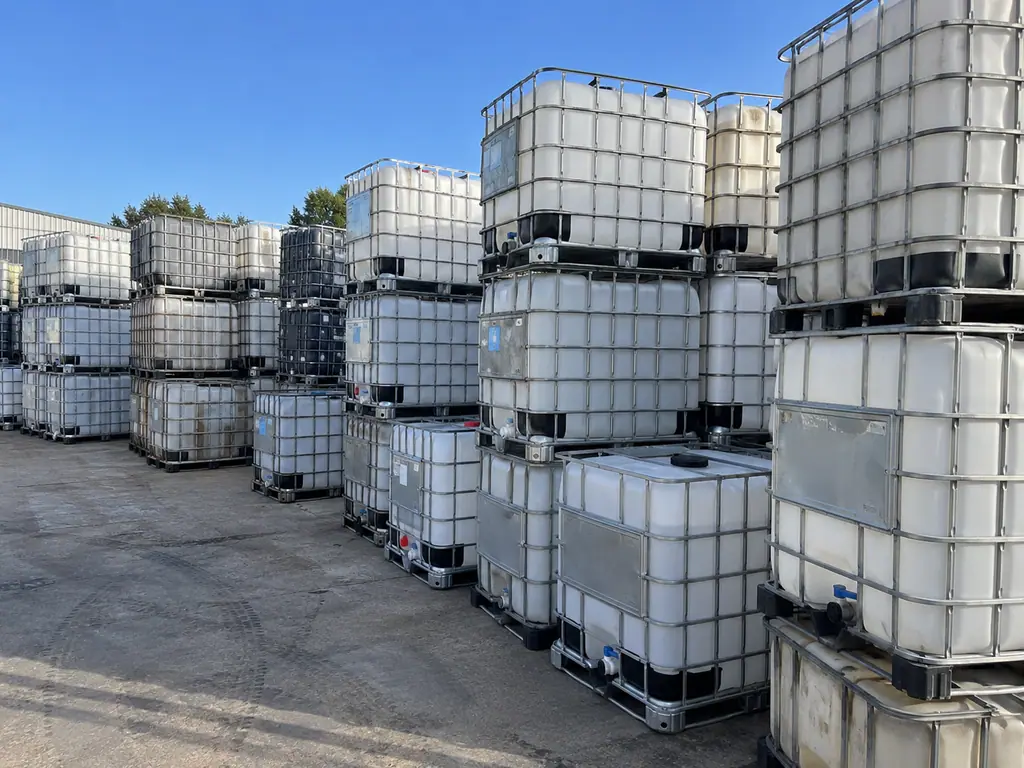
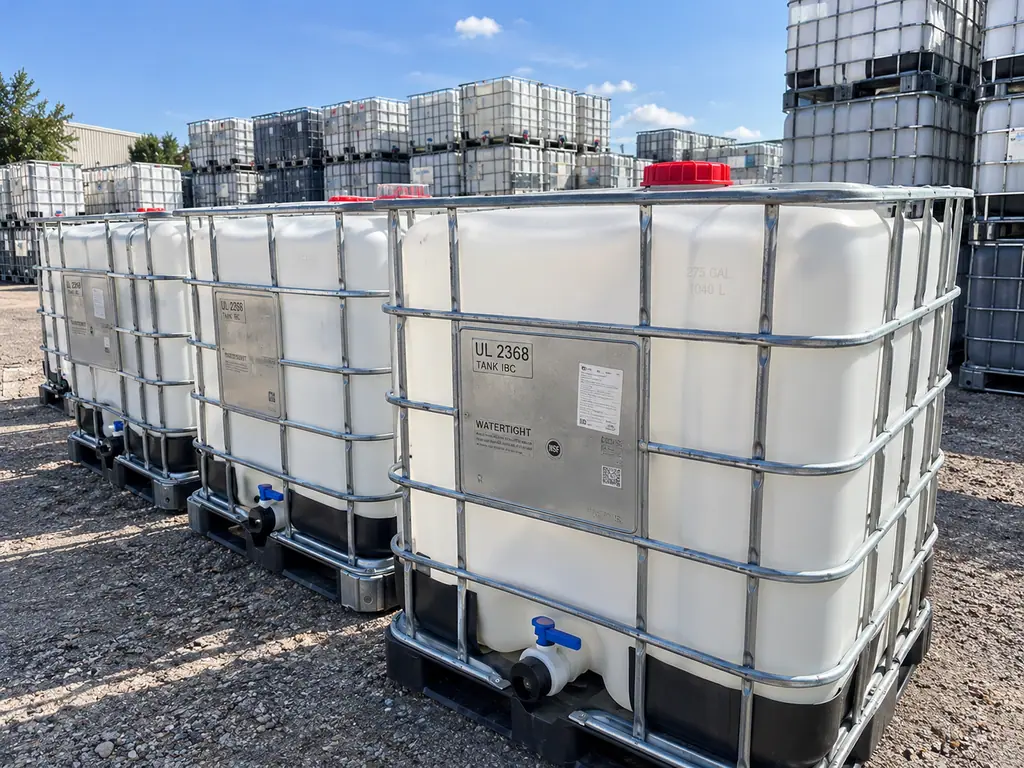
We are in Livonia, Michigan. Four months of the year, the single largest destroyer of IBC totes in our region is water that somebody left in one. This is the checklist we send customers in the first week of October.
Why freeze damage is so expensive
Water expands roughly nine percent when it freezes, and it does it from the outside in, so the last water to freeze is trapped in the middle with nowhere to go. The bottle takes the load. The cage takes what the bottle passes on.
The result is rarely a dramatic split. It is a bottle that has swollen, a cage that is now a few degrees out of square, and a unit that will weep at a seam next summer with your product in it. Freeze damage does its billing later.
The October checklist
- Drain every outdoor tote to two-thirds, or empty it completely. Two-thirds gives the ice somewhere to go.
- Open and drain every outlet valve, then leave it cracked. A closed valve full of water is the first thing to split.
- Remove and store hose adapters and camlocks. Brass fittings full of ice crack at the hex and you will not notice until spring.
- Fit vented caps. Thermal cycling in winter sunshine is as hard on a sealed bottle as summer heat.
- Check that units are on firm ground, not on soil that will heave. Frost heave tips totes.
- Move anything you need all winter indoors, or jacket and heat it.
- Photograph the fleet. In April you will want to know what the damage looked like in October.
Products that are not water and still freeze badly
| Product | What happens cold | Recovery |
|---|---|---|
| Liquid fertilizer / UAN | Salts crystallise out below ~20°F | Agitate warm; often recoverable |
| Polymer / coagulant | Separates irreversibly | Usually a write-off |
| Sodium hypochlorite | Degrades faster warm, slushes cold | Store cool, dark, vented |
| Vegetable oil | Solidifies, will not pump | Warms back without harm |
| Honey / syrup | Crystallises | Gentle heat, jacket recommended |
| Latex paint | Freezes and curdles | Write-off |
Heating and jacketing, briefly
An insulation jacket slows heat loss; it does not add heat. If a product must stay above a threshold all winter, you need a jacket and a thermostatically controlled band heater, and you need a safe power supply for it. We fit both, and we will tell you when the cheaper answer is to move the tote indoors instead.
Never put an immersion element inside a bottle. The failure mode is a hole in a full tote, and it tends to happen at three in the morning.
What to do in April
Inspect before you fill. Look at the shoulders and the corners for whitened stress marks, check the cage for square by pushing a top corner, and fill with water first if you are unsure. A tote that survived the winter will tell you so with a thirty-minute water test.