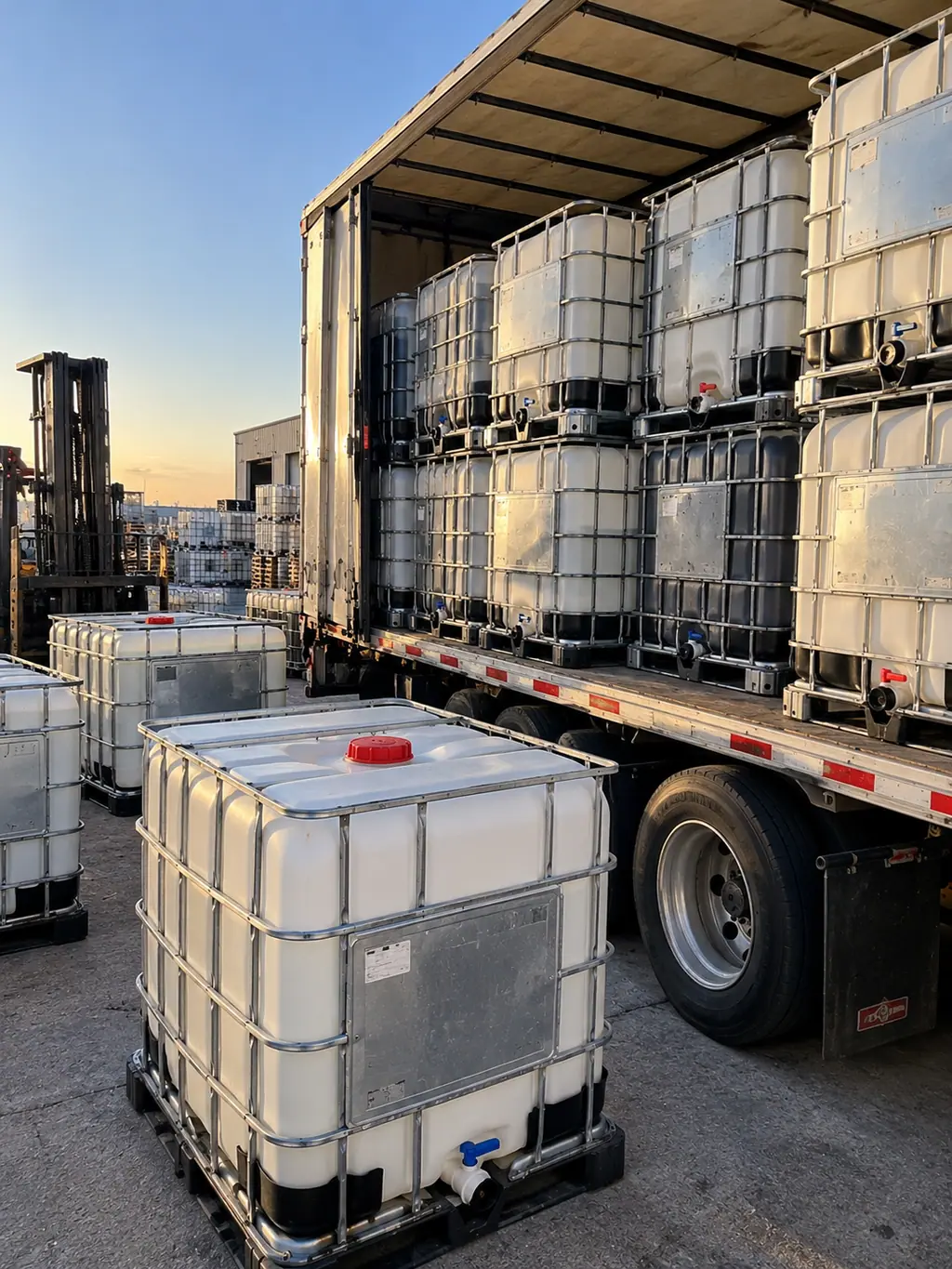
The thing nobody else does
Used totes are
normally anonymous.
Ours have files.
A second-hand container is only as trustworthy as its history. So in 2016 we started stencilling an ID on every cage that leaves the yard and keeping its record. This page lets you read one.
Try it
Decode a cage ID
Type an ID from a cage you own, or use one of the samples. Cages already in our yard resolve to their logged history; anything else resolves to a modelled one so you can see exactly which fields we keep.
- Format and current grade
- Cage build year and bottles fitted
- Service loops completed
- Wash chemistry and repair events
- Road miles logged with us
- Cumulative CO₂e avoided versus buying new each time
The ID is stencilled on the upper rail of the cage, in white, next to our mark. If yours has worn off, send us four photographs and we can usually identify the unit from the manufacturer plate and the repair pattern.
Format
330 gal / 1,250 L
Current grade
Rebottled
Cage born
2020
Service loops
3
Bottles fitted
3
CO₂e avoided
336 kg
Road miles logged
1,240
Landfill mass avoided
450 lb
Service history
- 2020Cage pressed and galvanised. First bottle fitted at Windsor, ON.
- 2021First commercial fill — Hydraulic fluid.
- 2025Bottle fatigue flagged at intake. Rebottled with new HDPE; cage straightened and re-footed.
- 2026Triple rinse on our line. Valve and gasket replaced, leak-held for 30 minutes.
- Loop 2Returned empty from Toledo, OH. Cage graded Rebottled.
- NowIn service with a Michigan grower
Cages already in our yard resolve to their real logged history. Any other ID resolves to a modelled one, so you can see the exact fields we keep — build year, bottle changes, wash chemistry, loop count and avoided emissions — before a tote ever reaches your dock.
Why it exists
A customer asked a question we could not answer
In 2016 a buyer asked how we knew a cage was on its third life rather than its ninth. We did not know. Six weeks later every cage leaving the yard had an ID and a file.
It makes grading honest
When the history is written down, a grader cannot quietly round up. The file either says the bottle was replaced or it does not.
It makes reuse auditable
Regulated buyers can accept reused equipment when its history is documented. The paperwork is what unlocks reuse for serious QA programmes.
It makes impact real
Loop count × avoided emissions per loop is a number you can put in a sustainability report and defend, because the loops are logged individually.
The record
Every field we keep per cage
This is the whole schema. There is nothing else in the file and nothing hidden from you.
| Field | Captured at | Why it matters to you |
|---|---|---|
| Cage ID | First intake | The key to everything else |
| Manufacturer & plate data | First intake | Identifies the design and its original rating |
| Build year | First intake | Steel age, which drives repair expectation |
| Bottle serial & fit date | Every bottle change | Tells you whether the interior is virgin or reused |
| Last contents | Every intake | The single most important fact about a used tote |
| Wash category & parameters | Every wash | Chemistry, temperature, hold time |
| Repair events | Every repair | Welds, feet, straightening, galvanising |
| Leak-hold result | Every reconditioning | Pass/fail with duration |
| Grade assigned | Every outbound | And the inspection notes behind it |
| Photo set | Every intake & outbound | Six angles including the marking panel |
| Loop count | Derived | How many service cycles this cage has completed |
| Road miles | Derived | Freight carried on our own lanes |
| Avoided CO₂e | Derived | Loop count × 112 kg, with methodology published |
Passport questions
Reasonable scepticism, answered
Is this just a serial number with marketing around it?
What happens if I buy a tote and later sell it back to you?
Can I see the file for a tote I already own?
Does the passport make the tote UN rated?
What do the IDs that are not in your yard show?
Buy a tote with a history.
Ask for the passport files on any lot we quote. They arrive before the invoice does.