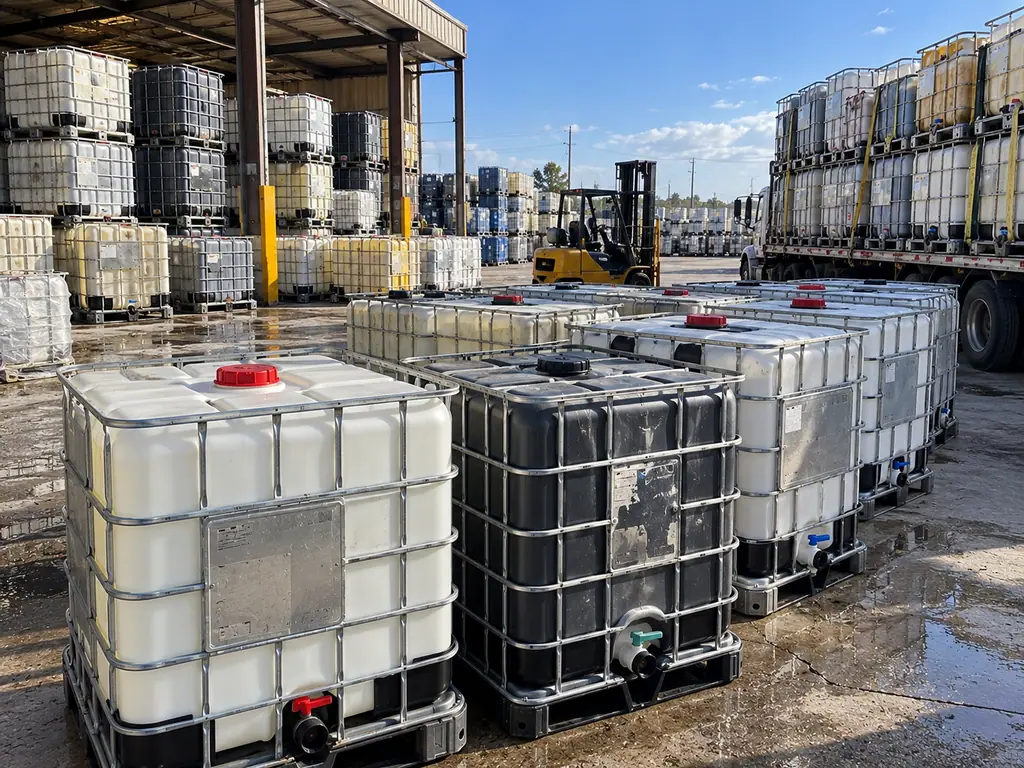
Chapter 06 · UN / DOT markings
The marking
panel tells the
whole truth.
A UN rating is not a brand or a model feature. It belongs to one specific marked unit, in the condition it was tested, and the string stamped on the panel tells you exactly what was proven about it.
The string, decoded
31HA1 / Y / 26 / 2104 / USA / +AB1234
Read it left to right. Every field answers a different question, and if any field is missing or illegible the unit cannot be presented as rated.
| Field | Example | Means |
|---|---|---|
| IBC type code — digit 1 | 3 | Composite IBC for liquids (31 = liquids, 11 = solids discharged by gravity, 21 = solids under pressure) |
| IBC type code — digit 2 | 1 | Intended for liquids |
| Material letter | H | Plastic (A = steel, B = aluminium, N = other metal, H = plastic, HZ = composite with plastic inner) |
| Inner / outer designation | A1 | Rigid plastic inner receptacle with an outer steel frame |
| Packing group | Y | X = PG I, II and III · Y = PG II and III · Z = PG III only |
| Stacking / design indicator | 26 | Year or design code segment, as applied under the test report |
| Date of manufacture | 2104 | Month and year the unit was manufactured — here, 21st week or month coding per the scheme used |
| State of authorisation | USA | Country whose competent authority approved the design |
| Manufacturer / approval code | +AB1234 | The registration identifying who built or reconditioned it |
What sits behind the marking
The tests that earned it
A rating is a record of destructive testing on sample units of that design, plus periodic retesting of production and reconditioned units.
- Drop test — filled, dropped from a height tied to the packing group
- Leakproofness test — internal air pressure, held and checked
- Hydraulic pressure test — internal pressure well above service
- Stacking test — loaded for an extended period at a multiple of its own gross mass
- Bottom lift and top lift — handled as it will be handled in service
- Vibration test — simulating road and rail transport
Periodic retest and inspection intervals apply to units in regulated service. Those intervals are a shipper obligation, and we will tell you where a unit sits in its cycle when we have the records.
What voids a marking instantly
- Replacing the inner bottle outside a licensed reconditioning programme
- Welding, drilling or cutting the cage
- Fitting a valve or fitting not covered by the original approval
- Repairing structural damage without re-testing and re-marking
- An illegible or painted-over marking panel
After any of those, the unit is a perfectly good non-UN tote. It is simply no longer a legal hazmat packaging until a licensed reconditioner re-tests and re-marks it.
How we route recertification →Compliance questions
The ones that matter commercially
Can you sell me a UN-rated reconditioned tote?
Does the Y rating cover my product?
I only store the product on site. Do I need a UN tote?
The panel is faded. Is it still valid?
Is a DOT marking the same as a UN marking?
This page is reference material from a reconditioning yard, not regulatory advice. For a specific shipment, confirm your obligations with your carrier or a dangerous-goods advisor.
Ready to put a tote back to work?
Send one form. We answer with real numbers — grade, quantity, freight, lead time.