IBC·RecycleReuse · Recondition · Return
Livonia, MI · Est. 2009Contact Us

Product types

Six kinds of IBC.
You probably want
the first one.

A caged composite tote on a steel pallet is the right answer most of the time. The other five types exist for specific reasons, and this page is about those reasons.

Not sure which type fits?Describe the job — we will tell you

* requiredPhone & postal code: US or Canada onlyQuantity 1–10,000

No phone calls from us — we answer by email from sales@ibc-recycle.com. Privacy

Type by type

What each one is actually for

Pros and cons as our graders describe them, not as a catalogue describes them.

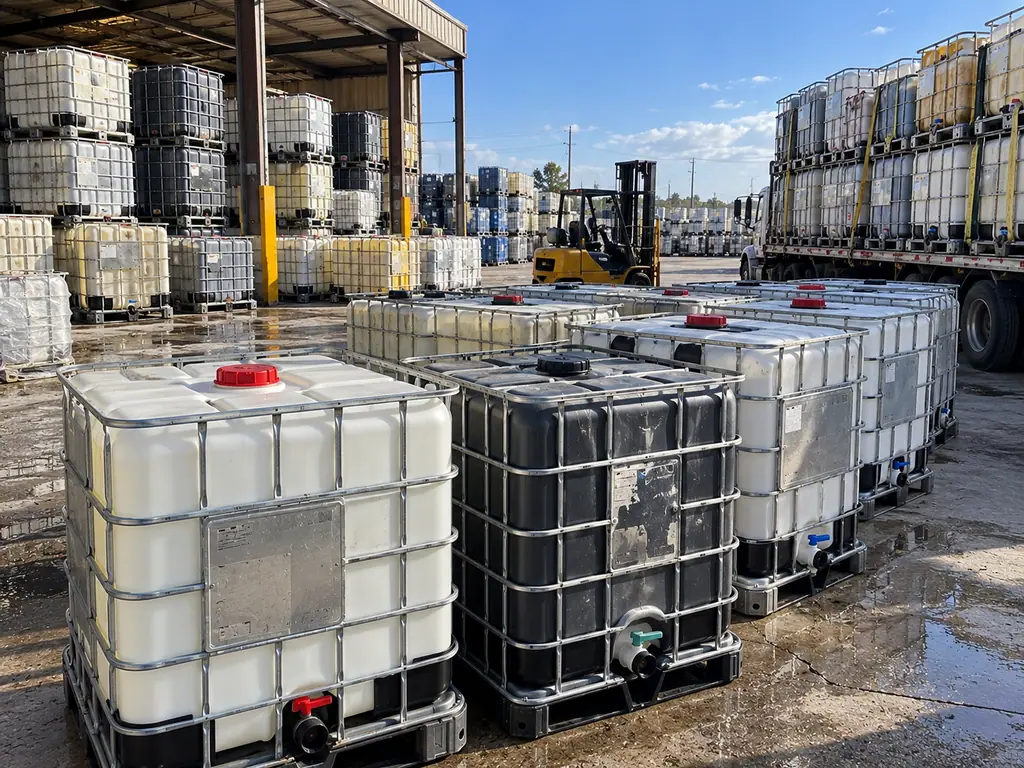
HDPE bottle inside a galvanised tubular steel cage on an integral pallet.

Caged composite (the standard IBC)

Ninety-odd percent of the world's IBCs. Cheap to make, cheap to ship, stackable, repairable and — crucially — separable into two recyclable materials at end of life. The bottle is the consumable; the cage is the asset.

Strengths

  • Lowest cost per gallon
  • Repairable and rebottlable
  • Universal fittings and handling

Limitations

  • HDPE permeates with some solvents
  • UV degrades bare bottles outdoors
  • Not pressure rated
Welded 304 or 316 stainless vessel on an integral frame.

Stainless steel IBC

Effectively permanent. Steam-cleanable, pressure and vacuum rated in many builds, immune to permeation and UV. Ten times the price and three times the tare weight of a composite, which is why they only make sense for repeated high-value service.

Strengths

  • Indefinite service life
  • Steam and CIP cleanable
  • No permeation, no UV damage

Limitations

  • Heavy — 300 to 600 lb empty
  • Expensive to buy and to freight
  • Dents are a repair job, not a swap
A composite or steel IBC marked and tested for regulated hazmat transport.

UN / DOT rated

The rating belongs to the specific marked unit, not to the model. Drop, leak, hydrostatic and stacking tests sit behind that marking panel, and reconditioned units must be re-tested and re-marked under a licensed programme to keep it.

Strengths

  • Legal for regulated road, rail and sea shipment
  • Documented test regime

Limitations

  • Premium price
  • Re-marking requires a licensed reconditioner
  • Marking invalid after unauthorised repair
Cage and bottle designed to fold flat for return freight.

Folding / collapsible

Built for closed-loop programmes where empties ride back. Folded units cut return freight volume by roughly 70%, which matters enormously on long lanes and not at all on local ones.

Strengths

  • Cheap return freight
  • Less warehouse footprint empty

Limitations

  • Higher unit cost
  • More moving parts to damage
  • Rare on the used market
A composite IBC with an insulation jacket, or a built-in heating element.

Insulated & heated

For products that gel, crystallise or freeze — resins, honey, certain surfactants, winter-stored water. Jackets can be retrofitted to any standard cage, which is usually the cheaper route.

Strengths

  • Retrofittable jackets
  • Keeps viscous product pumpable

Limitations

  • Jackets wear and need replacing
  • Electrical heating needs a safe supply
A bottle with a cone or sloped floor for near-complete drainage.

Conical / sloped base

If your product is expensive or your cleaning regime is strict, the few litres left in a flat-bottomed bottle matter. A sloped base recovers most of it.

Strengths

  • Near-full discharge
  • Easier to clean out

Limitations

  • Slightly less capacity per height
  • Scarcer on the used market

Decision table

Match the job to the type

If you are storing…Buy thisWhy
Non-potable water, wash fluid, coolantReconditioned caged compositeCheapest competent answer. Grade can be technical.
Drinking water, syrup, edible oilsFood-grade or rebottled compositeDocumented food-only history is the whole point.
Liquid fertilizer, soap concentrateWashed caged composite (W3)Chemistry is forgiving; triple-rinse is sufficient.
Regulated hazmat for shipmentUN/DOT rated, recertifiedThe marking is the licence to ship.
Aggressive solventsStainless steelHDPE permeates; the bottle will never be trustworthy again.
Product that gels or freezesComposite + insulation jacketRetrofit is far cheaper than a heated vessel.
High-value product needing full dischargeConical baseRecovers the few litres a flat floor keeps.
Long-lane closed-loop programmeFolding IBC, or our tote pooling serviceReturn freight is the dominant cost on long lanes.

Type questions

The ones that come up on the phone we don't have

Can I put a composite tote outside year-round?
Yes, with two caveats. Bare HDPE yellows and embrittles under UV over several years, so a cover or a shaded position roughly doubles bottle life. And if you fill it with water in Michigan, leave headspace — ice expands and will bulge or split a full bottle.
Are the pallets interchangeable?
Mostly. Steel, composite and plastic bases all take the same 48 × 40 footprint, but they differ in weight, in how they behave on a wet floor and in whether a pallet jack can get under them. Tell us your handling equipment and we will match the base.
What does 'one-trip' actually mean?
A tote that has been filled exactly once by the original product manufacturer and then emptied. Functionally almost new, priced below new, and the single best value in this industry if you can get them. We stock them when we can.
Can you convert a composite to a heated unit?
We fit insulation jackets and band heaters in bay 5. We do not modify bottles to accept immersion elements — the failure mode is a hole in a full tote and nobody wants that.

Ready to put a tote back to work?

Send one form. We answer with real numbers — grade, quantity, freight, lead time.