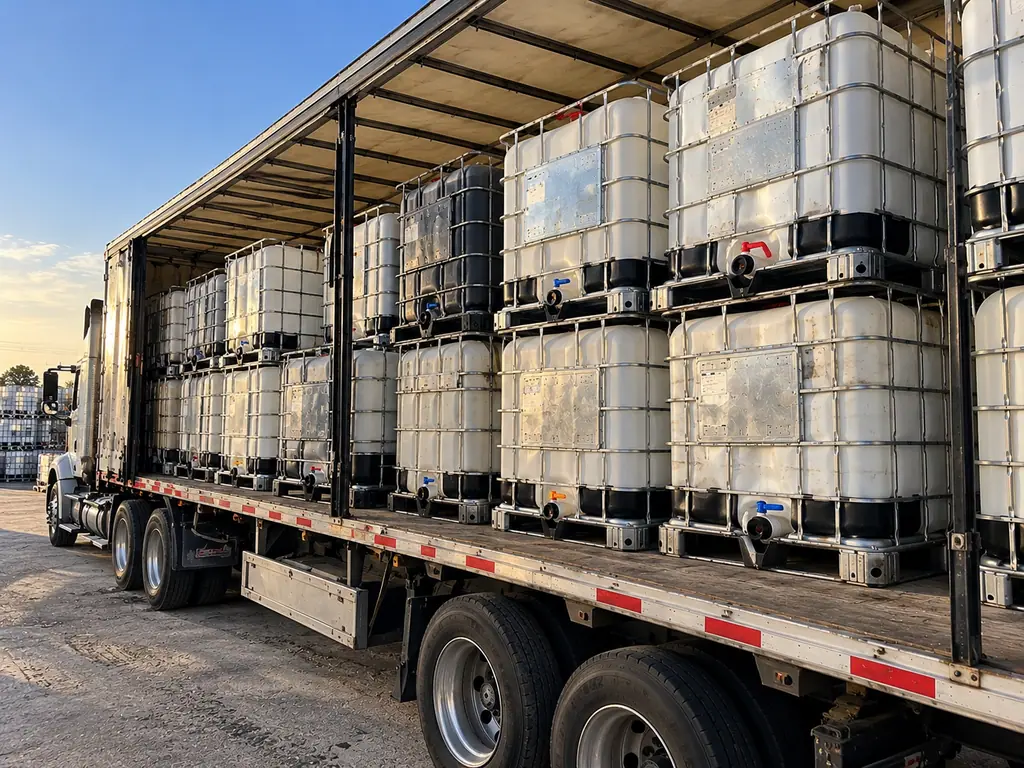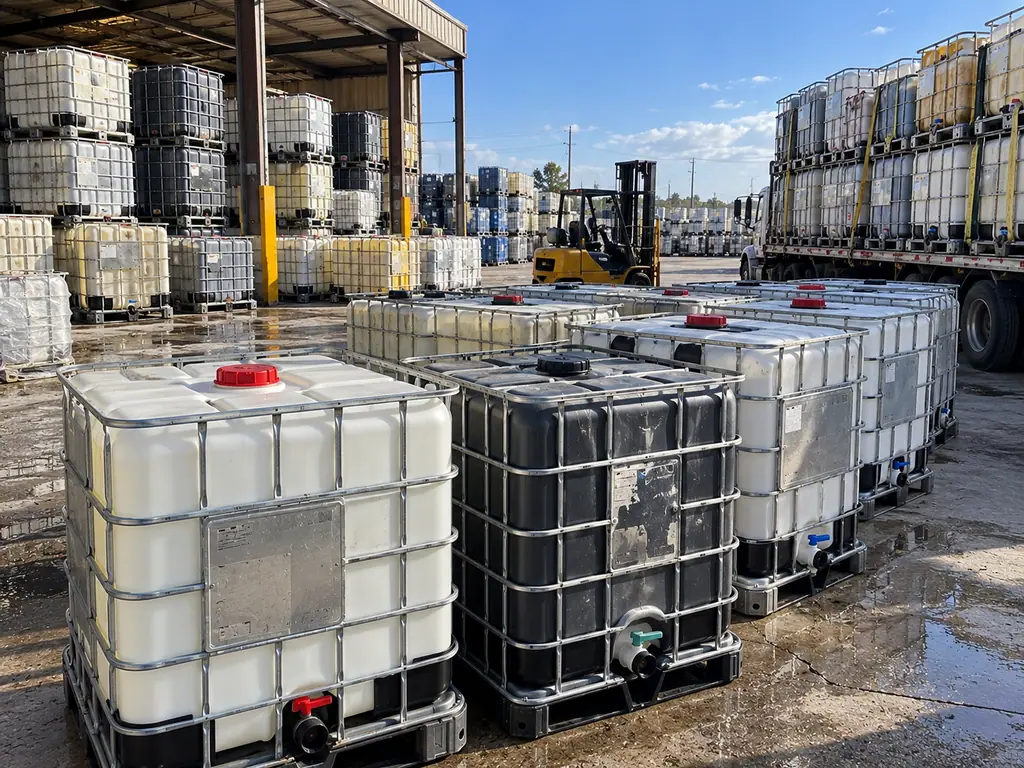
Four words do almost all the work in a used-tote listing: rinsed, washed, reconditioned, rebottled. None of them is regulated. All of them are used loosely. Here is what each one buys you when we use it, and what to ask when somebody else does.
Rinsed
Water went in and came out. On our line that means a single pass, residue-free to visual inspection, with the last contents disclosed in writing. It is the cheapest honest thing you can buy and it is entirely appropriate for non-potable water, slurry, ballast and waste collection.
Ask: “once, or three times?” A genuine triple rinse is three separate fill-agitate-drain cycles, not three passes with a hose. For agricultural chemicals that distinction is the entire point of the procedure.
Washed
Multi-stage, with chemistry chosen from the last-contents record. Our washed grade means pre-rinse, then hot caustic at 140 to 160°F or live steam, then a clean rinse, then forced drying — with the stage sequence, chemistry, temperature and hold time on the record. New valve and gasket as standard, and a thirty-minute leak hold under pressure before it is graded.
Ask: “what chemistry, at what temperature, for how long?” If the answer is an adjective rather than three numbers, it is not a wash protocol.
Reconditioned
The broadest and most abused of the four. For us it means the whole programme: logged and photographed at intake, last contents verified, washed to chemistry, valve and gasket replaced, cage straightened and re-footed, leak-held, graded, and stencilled with a passport ID. For some sellers it means “we hosed it and tightened the valve”.
Ask: “what did you do to the cage?” Washing is about the bottle. If nobody touched the steel, it was not reconditioned, it was cleaned.
Rebottled
The bottle is brand new — never filled, from a current production run — fitted into a refurbished cage on a reused pallet. This is the most under-used option in the industry and the one we recommend most often to customers who think they need to buy new.
You get a genuinely virgin interior, which satisfies most QA programmes, at roughly 60% of the price of a new unit and about 42% of its embodied carbon. The cage — the part that has already proved it can survive a decade of forklifts — stays in service.
Ask: “is the bottle new, or new to this cage?” It is a genuine ambiguity and the difference matters.
Side by side
| Word | Bottle interior | Documentation | Relative price | Suitable for food? |
|---|---|---|---|---|
| Rinsed | Prior contents, single rinse | Last-contents disclosure | 0.6× | No |
| Washed | Prior contents, multi-stage clean | Full wash record | 1.0× | No |
| Reconditioned | As washed, plus cage work | Wash record, grade sheet, passport | 1.1× | Only if graded food |
| Rebottled | Virgin HDPE | New-bottle cert plus cage passport | 1.6× | Yes |
| New | Virgin HDPE, new cage | Manufacturer documentation | 2.4–3.0× | Yes |
The one-sentence version
Rinsed is for things nobody drinks, washed is for industrial chemistry, reconditioned should include the steel, and rebottled is how you get a virgin interior without paying for new steel you do not need. Grade definitions in full are on the grades chapter.